
If Ransomware Hit Tonight, Would Your Business Open Tomorrow?
Ransomware preparedness is not really about whether your organization can prevent every attack. The more important question may be what happens the morning after one succeeds.
Imagine arriving at work tomorrow morning and discovering that nobody can log in.
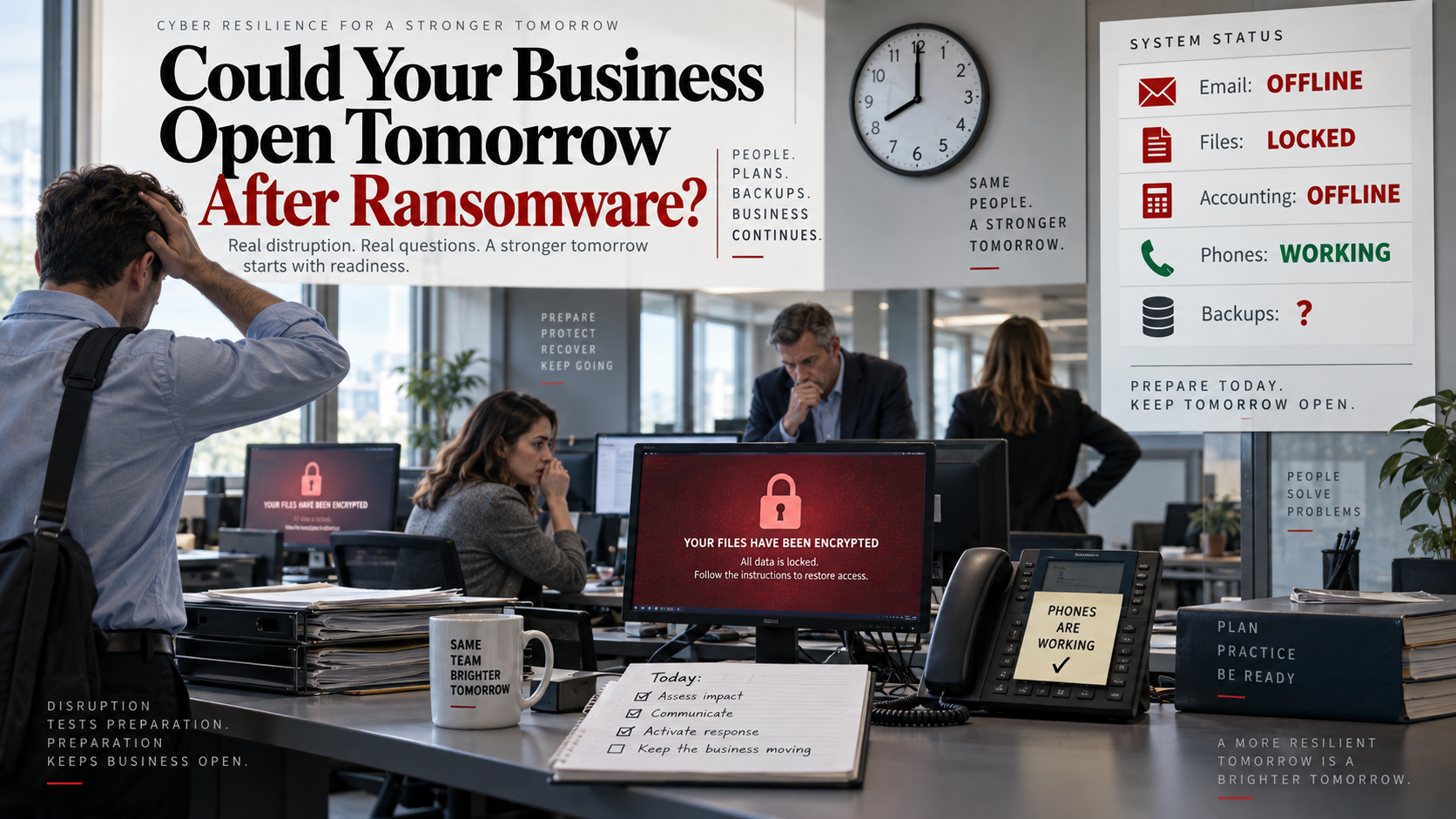
Email is unavailable. Shared files will not open. Your accounting system is inaccessible. Employees cannot reach customer records. Production systems are offline. Phones may still ring, but the people answering them cannot access the information they need to help anyone.
Then someone notices a message on the screen.
Your files have been encrypted.
For many organizations, this is the moment when the real cost of ransomware begins.
Cybersecurity discussions often focus on preventing an attack. Prevention is essential, but no defence is perfect. Organizations also need to answer a much more uncomfortable question:
If ransomware got through tonight, could the business still operate tomorrow?
Ransomware Is a Business Problem, Not Just an IT Problem
A ransomware attack does not simply affect computers.
It can stop an organization from serving customers, processing payments, manufacturing products, scheduling appointments, accessing patient or client records, communicating with employees, paying suppliers or running payroll.
That makes ransomware a business continuity issue.
The IT department may be responsible for rebuilding systems, but the consequences quickly spread throughout the organization.
Sales may lose access to customer information. Accounting may lose access to financial systems. Operations may lose scheduling or inventory data. Management may suddenly need to communicate with employees, customers, insurance providers, legal counsel and possibly regulators.
And all of those decisions may need to happen while the normal communication systems are unavailable.
Having a Backup Is Not the Same as Being Able to Recover
One of the first questions organizations ask after a ransomware attack is usually:
“Do we have backups?”
That is important, but it is not enough.
The better question is:
“When was the last time we successfully restored our systems from those backups?”
A backup that has never been tested is ultimately an assumption.
Organizations may discover after an incident that backups are incomplete, corrupted, outdated or inaccessible. In other cases, attackers may have gained access to the backup environment before launching the ransomware attack.
This is why a strong backup strategy should include multiple layers of protection, including protected or immutable copies that cannot easily be altered by an attacker.
Just as importantly, restoration should be tested regularly.
You do not want the first full recovery test to happen while your organization is already experiencing a crisis.
What Would You Restore First?
Even with excellent backups, restoring an entire organization can take time.
That means businesses should determine their recovery priorities before an incident occurs.
Which systems absolutely must be available for the organization to function?
- Email and communication systems
- Accounting and financial software
- Customer relationship management systems
- Electronic medical or client records
- File servers and document management
- Inventory and warehouse systems
- Manufacturing or operational technology
- Cloud applications
- Identity and authentication systems
- Remote access platforms
The answer will be different for every organization.
A manufacturer might consider production systems critical. A law firm may prioritize document management. A medical clinic may need immediate access to patient information. A construction company may depend heavily on project management and accounting platforms.
The important part is deciding before the emergency which systems come first.
Your Recovery Plan Cannot Live on the Network You Are Trying to Recover
There is another surprisingly common problem.
An organization creates a detailed incident response plan and carefully stores it on the company network.
Then ransomware encrypts the network.
Now the instructions explaining what everyone should do during the ransomware attack are trapped inside the ransomware attack.
Critical incident response information should be available independently of normal production systems.
That includes contact information for key employees, IT providers, cybersecurity specialists, insurance providers, legal counsel and other important response partners.
Decision-makers should also know who has authority to make important decisions during an incident.
Could Your Business Operate Without Email?
This is one of the simplest ransomware preparedness exercises an organization can perform.
Ask your management team:
How would we communicate tomorrow morning if our normal email and collaboration systems were unavailable?
Do managers have alternate contact information for employees?
Does anyone have a current employee phone list?
Could the organization communicate with customers?
Could employees reach the IT provider?
Would everyone know who is responsible for coordinating the response?
These questions may sound basic, but they become extremely important when normal communication tools disappear.
Know What Technology Your Organization Actually Depends On
Modern businesses often rely on far more technology than management realizes.
A company may use Microsoft 365, accounting software, cloud file storage, payroll services, industry-specific applications, remote access tools, customer portals, mobile devices, security systems and dozens of smaller cloud applications.
Some of those services may have been purchased directly by individual departments without ever becoming part of a formal IT inventory.
During a ransomware incident, discovering these dependencies one at a time makes recovery considerably more difficult.
A current technology inventory should identify critical systems, where important information is stored, who manages each service and how it can be recovered.
Do Not Forget Identity Systems
Organizations naturally think about files and servers when discussing ransomware, but identity systems are equally important.
If an attacker controls administrator accounts, Microsoft 365 identities, remote management tools or other privileged credentials, simply restoring files may not solve the problem.
The attacker could still have a way back into the environment.
Recovery therefore needs to include more than restoring data. Organizations may need to reset passwords, revoke active sessions, secure privileged accounts, investigate how the attacker entered the environment and confirm that unauthorized access has been removed.
Practise the Bad Day Before It Happens
You do not have to shut down the network to test ransomware preparedness.
A simple tabletop exercise can reveal significant gaps.
Gather several key people and present this scenario:
It is 7:30 Monday morning. Employees cannot access company systems. Files have been encrypted and a ransom message has appeared. What happens next?
Then walk through the response.
- Who gets called first?
- Who determines the extent of the incident?
- Who contacts the IT provider?
- How will employees communicate?
- Which systems should be restored first?
- Where are the backups?
- When were they last tested?
- Who communicates with customers?
- Who contacts the cyber insurance provider?
- Who coordinates legal or regulatory requirements?
- How will management know when systems are safe to use again?
You may discover that some of the answers are unclear.
That is exactly why the exercise is valuable.
A Ransom Payment Is Not a Recovery Plan
No organization should build its ransomware strategy around the assumption that paying an attacker will solve the problem.
Even if encrypted information can eventually be recovered, systems still need to be investigated, credentials secured and the original path into the environment identified.
Data may also have been stolen before encryption occurred, creating additional privacy, legal and reputational concerns.
A real ransomware recovery strategy assumes that the organization must be capable of rebuilding and restoring its operations independently.
Ask These Questions Today
Before the next business day begins, every organization should be able to answer a few basic questions:
- What are our most critical systems?
- Where is our important data stored?
- Do we have protected backups?
- When did we last successfully restore from those backups?
- How quickly could we recover critical operations?
- Who would coordinate our response?
- How would employees communicate if email was unavailable?
- Do we have an incident response plan?
- Have we ever tested that plan?
If the answers are uncertain, that does not necessarily mean your organization is unprepared.
It means you have identified where the work needs to begin.
The Goal Is Resilience
Cybersecurity cannot guarantee that an organization will never experience an attack.
What good cybersecurity can do is make attacks more difficult, detect suspicious activity sooner, limit how far an attacker can move and give the organization a realistic path back to normal operations.
That last part is sometimes overlooked.
Backups, incident response plans, security monitoring, identity protection, employee awareness and recovery testing are not separate cybersecurity projects. Together, they create resilience.
And resilience may ultimately determine whether a ransomware incident becomes a manageable disruption or a business-changing event.
So perhaps the most useful cybersecurity question your organization can ask this month is not:
“Could ransomware happen to us?”
Ask this instead:
“If ransomware hit tonight, would we be ready to open tomorrow?”
Is Your Organization Ready for a Ransomware Incident?
Ransomware preparedness involves much more than installing security software. Your organization needs protected backups, secure identities, monitored systems and a tested recovery plan.
If you are unsure how quickly your business could recover from a serious cyber incident, our team can help you assess your current environment, identify potential gaps and build a practical cybersecurity and business continuity strategy.
The best time to discover a weakness in your recovery plan is before you need it.